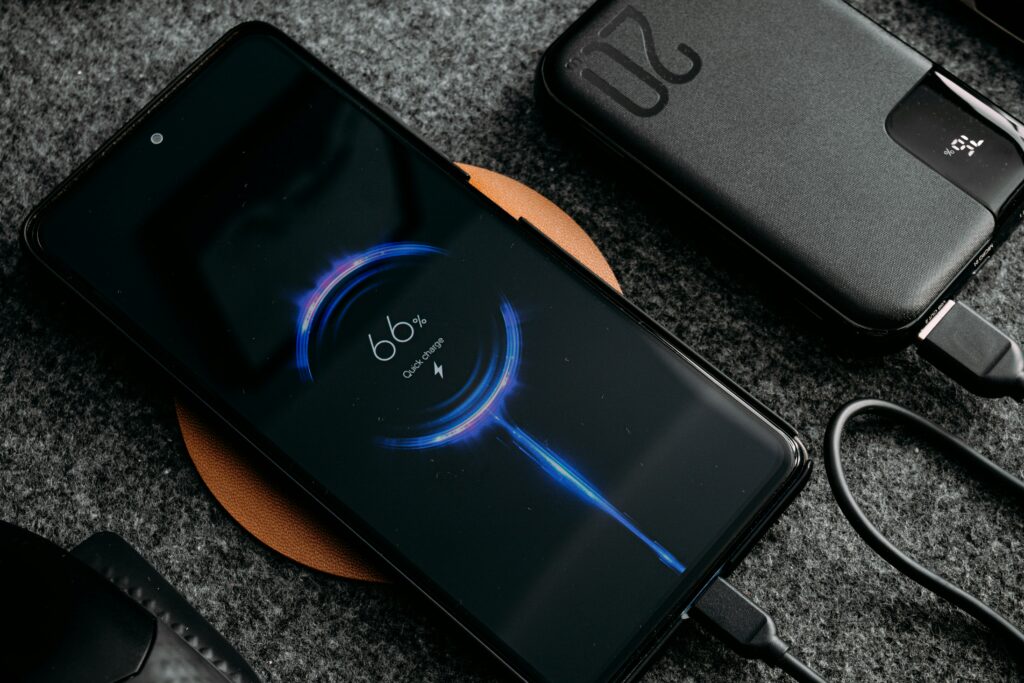
Here’s a puzzle that has confused a great many people. You buy a 10,000mAh power bank. Your phone has a 5,000mAh battery. Logically, you should get two full charges.
You get one and a bit. Sometimes barely that.
Nobody lied to you. The number on the box is accurate. It just doesn’t mean what the packaging implies, and understanding why will make you a substantially better buyer.
What mAh actually measures
Milliampere-hours measure electrical charge, but crucially, charge at a specific voltage. A capacity figure without a voltage is incomplete information.
Almost all power banks are built from lithium cells operating at a nominal 3.7 volts. So a 10,000mAh power bank stores 10,000mAh at 3.7V, which works out to 37 watt-hours of energy.
But USB output isn’t 3.7 volts. It’s 5 volts as standard, and higher with fast charging protocols. Converting 3.7V to 5V doesn’t create energy; it trades current for voltage.
Run the arithmetic: 37 watt-hours delivered at 5 volts gives roughly 7,400mAh of usable output, before accounting for any losses at all.
That’s the first and largest reason for the shortfall, and it applies to every power bank ever made.
Conversion losses
The circuitry that steps voltage up and manages charging isn’t perfectly efficient. Some energy becomes heat, which is why a power bank warms up while charging your phone.
Typical conversion efficiency runs between 85 and 90 percent for decent units. Applying that to our 7,400mAh: you’re now looking at roughly 6,300 to 6,600mAh actually delivered.
Then your phone’s own charging circuitry has losses too, typically another 5 to 10 percent.
Realistic figure: a 10,000mAh power bank delivers around 6,000 to 6,500mAh to your device. That’s about 65 percent efficiency, and it’s normal, not defective.
Against a 5,000mAh phone battery, that’s one full charge and roughly a quarter of a second, exactly what people experience and find confusing.
The rule of thumb
Multiply the stated capacity by 0.65 to estimate real-world delivery. Then divide by your device’s battery capacity.
A 20,000mAh bank delivers roughly 13,000mAh, about two and a half charges for a typical modern phone.
Any manufacturer claiming better than 70 percent real-world efficiency is either measuring generously or overstating.
Watt-hours: the number that matters more
Watt-hours (Wh) describe actual energy stored, independent of voltage, and are therefore the honest measure.
You’ll find this figure printed in small text on the unit itself, even when the packaging leads with mAh. It’s also the number airlines use.
Airline rules are worth knowing before you travel. Power banks must go in carry-on luggage, never checked baggage. Units under 100Wh are generally permitted without approval. Between 100Wh and 160Wh typically requires airline approval, and there’s usually a limit on quantity. Above 160Wh is generally prohibited.
For reference, a 20,000mAh bank is roughly 74Wh, comfortably within limits. A 27,000mAh bank sits around 100Wh, right at the boundary.
Several airlines have tightened rules recently, with some requiring power banks to remain visible rather than in overhead bins. Check your carrier before flying.
Output power: frequently more important than capacity
A large power bank with weak output is a common and frustrating purchase.
If your phone supports 30-watt charging but your power bank outputs 10 watts, charging takes three times as long. On a bank with substantial capacity, you might spend two hours getting a phone to full.
Check the output specification, expressed as either wattage or as voltage/current combinations like 5V/3A, 9V/2A, 12V/1.5A. Multiply volts by amps for watts.
Also confirm the protocol matches your device. USB Power Delivery is the widespread standard, particularly for USB-C and laptops. Quick Charge is common on Android. Some manufacturers use proprietary fast charging that only reaches full speed with their own accessories.
A power bank supporting the wrong protocol will still charge your device, just at basic speed.
Charging laptops
If you intend to charge a laptop, requirements change substantially.
You need USB Power Delivery with sufficient wattage, typically 45 watts minimum for a lightweight laptop, 65 watts for comfortable charging, and 100 watts for larger machines.
You also need meaningful capacity. A laptop battery might be 50 to 80 watt-hours, meaning a 20,000mAh (74Wh) bank will deliver roughly one charge at best.
Check that the power bank’s USB-C port supports output at the required wattage, not merely input. Some ports are input-only, and this isn’t always clearly labelled.
Pass-through charging
This feature allows the power bank to charge your device while itself being charged from a wall outlet, useful when you have one socket and two things to charge.
Not all units support it. Those that do sometimes generate considerable heat during simultaneous operation, which is not ideal for battery longevity. Useful occasionally, not something to rely on nightly.
Safety considerations
Lithium cells store considerable energy in a small space, and poorly made units are a genuine hazard rather than a theoretical one.
Buy from established brands. The cost difference between a reputable power bank and an unbranded one is small; the difference in cell quality and protection circuitry is not.
Look for protection features: overcharge protection, over-discharge protection, short circuit protection, and temperature monitoring. Reputable manufacturers list these; questionable ones don’t.
Be suspicious of capacity claims that defy physics. A pocket-sized unit claiming 30,000mAh is almost certainly overstating. Energy density has physical limits, and a genuine 30,000mAh bank is noticeably heavy, around 500 grams.
Retire damaged units immediately. Swelling, deformation, unusual heat, or physical damage from a drop all mean the unit should be disposed of at an appropriate recycling point, not used. A swollen lithium cell is not a cosmetic issue.
Sizing for your actual needs
5,000mAh: pocketable, roughly half a phone charge realistically. Suits topping up during a day out.
10,000mAh: the most popular size for good reason. One full phone charge with margin, still portable, comfortably within airline limits.
20,000mAh: two to three phone charges, or one modest laptop charge. Noticeably heavier. Good for weekend travel or multiple devices.
Above 20,000mAh: genuinely heavy, approaching airline limits, and rarely necessary unless you’re charging laptops or spending time away from power entirely.
Most people over-buy here. A 20,000mAh brick that stays home because it’s too heavy provides less value than a 10,000mAh unit that’s actually in your bag.
Extending its life
Power banks are batteries, and they degrade like batteries.
Avoid storing at zero or a hundred percent for extended periods; somewhere around half charge is ideal for long storage. Avoid heat, which is the primary accelerant of battery degradation; a power bank left in a car in summer will age dramatically faster than one kept indoors.
Use it periodically rather than saving it for emergencies. A cell that sits unused for a year and is never cycled will often disappoint when you finally need it.
Expect meaningful capacity loss after roughly 300 to 500 full cycles, which for most users translates to two to four years of useful life.
The short version
Real-world output is roughly 65 percent of the stated mAh figure. Watt-hours are the honest measure and the one airlines care about. Output wattage often matters more than capacity. Buy from a reputable brand, size it to what you’ll actually carry, and keep it away from heat.